
1. Sizing method, defaults and what remains unknown
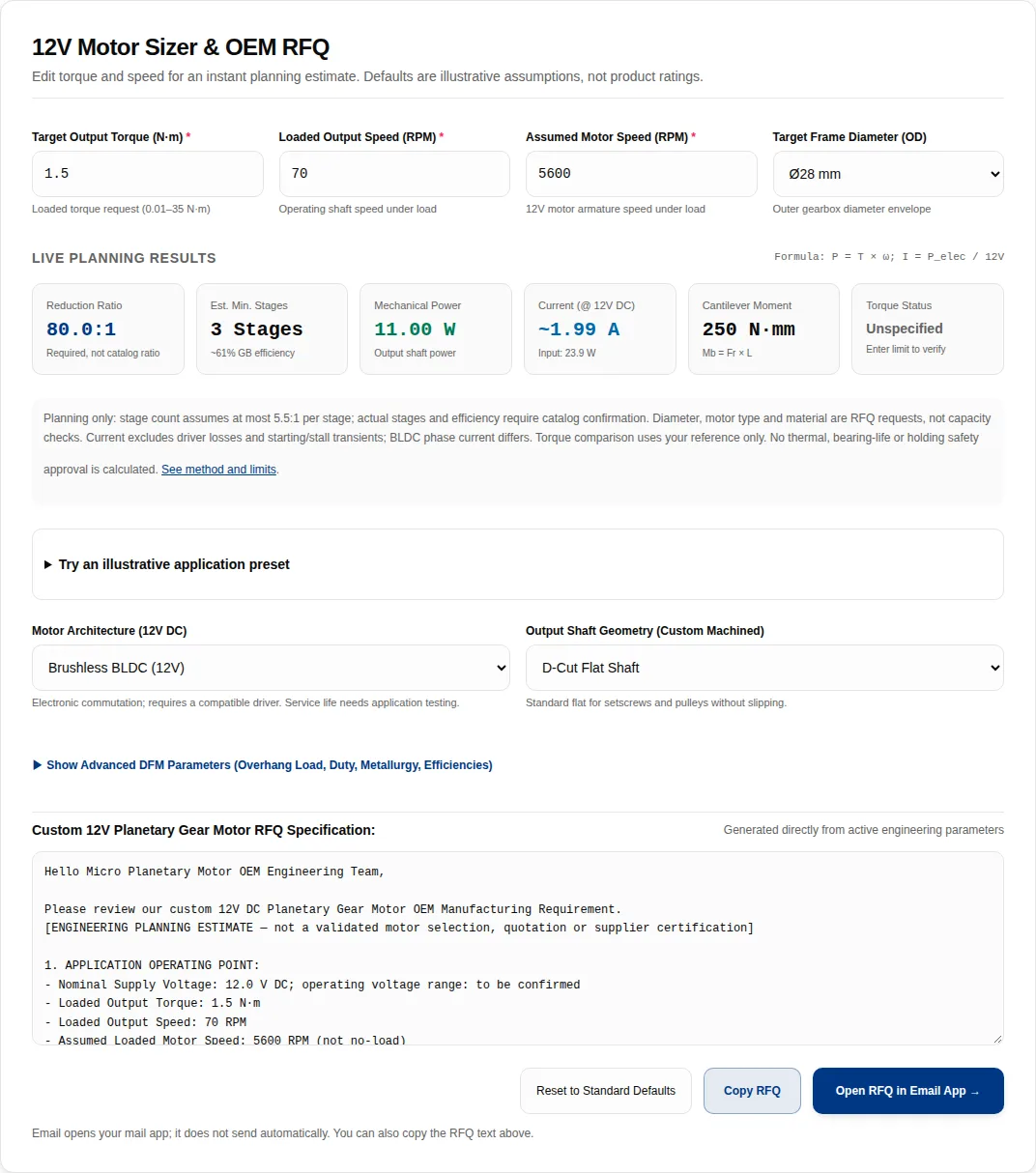
The tool models a steady operating point at nominal 12V. Required ratio i = loaded motor RPM / loaded output RPM. Output power P = T × 2πn / 60. Estimated gearbox efficiency is per-stage efficiency raised to the estimated stage count. Electrical input power is output power divided by motor and gearbox efficiency; DC supply current is that input power divided by 12V.
Boundary: Planning input range: 0.01–35 N·m, 1–2,500 output RPM, 800–25,000 loaded motor RPM, ratio 2–5,032.8. These are software limits, not available product specifications. Use the RFQ review path for values outside the range.
Source scope: maxon — Assigned power rating of DC / EC motors
On narrow screens, swipe the table sideways or focus it and use the arrow keys to compare all columns.
| Tool quantity | Method / default | Decision boundary |
|---|---|---|
| Reduction and stage count | Default: 5,600 / 70 = 80:1. N = ceil(log(i) / log(5.5)) = 3. | 5.5:1 per stage and a five-stage cap are model assumptions. Actual tooth counts, stage arrangement and input-speed limits need confirmation. |
| Power and loaded current | Default: 1.5 N·m, 70 RPM → 11.00 W output. 75% motor and 85% per-stage efficiency → about 1.99 A at 12V. | Excludes controller losses, no-load-loss variation and start/stall transients. Not a fuse or phase-current rating. |
| Requested diameter / material | Envelope and construction preferences are carried to the RFQ. | They do not change the power equations or establish that a matching motor can be manufactured. |
| User-entered torque reference | (Reference − demand) / reference × 100%. Blank means unknown. | This is headroom to your entered number, not a safety factor or a validated combined motor/gearhead rating. |
2. Motor and gear architecture trade-offs
Choose the control approach and mechanical construction before optimizing a quote. The options below describe design routes to discuss with a manufacturer. No universal life, acoustic level or material torque capacity is assigned to them.
Boundary: Editorial comparison framework. Product life, noise, efficiency and price are unknown until model-specific evidence and quotations are supplied.
On narrow screens, swipe the table sideways or focus it and use the arrow keys to compare all columns.
| Route | Potential advantage | Evidence to request / trade-off |
|---|---|---|
| Brushed PMDC | Simple two-wire power and polarity control. | Brush wear, commutation noise, duty life and start/stall current; a low purchase price can add maintenance cost. |
| Brushless BLDC | Electronic commutation avoids brush wear. | Compatible controller, feedback, speed range and supply/phase-current definitions; include driver cost. |
| Coreless DC | Low rotor inertia can suit responsive motion. | Confirm brush system, torque ripple and thermal capability; smooth motor torque alone cannot establish pump delivery accuracy. |
| Polymer / sintered / machined steel gears | Different process, noise and production cost trade-offs. | Grade, geometry, heat treatment, lubrication and load-life data. Material name alone does not rate a gearbox. |
3. Shaft loading and bearing verification
For the tool’s single radial load case, bending moment M = Fr × L, with L measured from the FRONT BEARING CENTER. A flange dimension must be converted using the drawing. The default 25 N at 10 mm gives 250 N·mm. Blank force or distance produces an unknown moment; zero is accepted only when explicitly entered.
Boundary: The tool does not calculate bearing reactions, shaft stress or L10 life. The >50 N notice is a review trigger, not a safe/unsafe boundary.
Source scope: ISO 281:2007 — Rolling bearing ratings and life
On narrow screens, swipe the table sideways or focus it and use the arrow keys to compare all columns.
| Required information | What it resolves | If unavailable |
|---|---|---|
| Load vector, distance and bearing span | Radial reactions and shaft bending; axial load needs its own check. | Request a dimensioned load sketch; do not substitute flange distance. |
| Bearing part number and dynamic rating | Inputs for rolling-bearing fatigue-life assessment. | Life is unknown. Do not infer a safe radial load from diameter or a 50 N notice threshold. |
| Shaft section, material and peak load | Bending, torsion and interface strength. | Review an external support bearing or belt arrangement to reduce overhang. |
4. Duty cycle, temperature and cold-start validation
Continuous and intermittent operation require different thermal evidence. Provide actual on/off times, acceleration, mounting, ambient and enclosure conditions. Changing to S3 in the tool does not increase the permitted torque or reduce the calculated loaded current.
Boundary: Motor efficiency and stage efficiency remain user assumptions. No product-specific lubricant range or thermal test result has been verified for this page.
Source scope: IEC 60034-1:2026 — Rating and performance
On narrow screens, swipe the table sideways or focus it and use the arrow keys to compare all columns.
| Condition | Minimum validation request | Avoid this assumption |
|---|---|---|
| Continuous operation | Mounted temperature-rise test with winding measurement method and acceptance limit agreed. | A material insulation class is not a permissible housing temperature or proof of continuous duty. |
| Intermittent operation | Cycle duration, on/off times, peak torque and repeated-cycle thermal logs. | A duty percentage alone does not define an equivalent thermal load. |
| Cold start | Lubricant product data, soak temperature/time and starting-current trace with the actual driver. | Base-oil pour point does not guarantee grease starting torque or a fixed current multiplier. |
| Hot sealed enclosure | Worst-case ambient, flange heat path and thermal shutdown behavior. | No universal torque derating factor or heat-removal percentage is established here. |
5. Acoustic and electrical noise acceptance
Write an acoustic test condition and an electrical emissions test plan separately. A quieter gear mesh and an EMI filter solve different problems. Neither can be accepted from a material label or an illustrative circuit alone.
Boundary: Ask for test reports tied to the exact motor, controller, wiring and configuration. Unspecified configurations remain unverified.
Source scope: ISO 3744:2025 — Sound power measurementCISPR 25:2021 — On-board receiver protection
On narrow screens, swipe the table sideways or focus it and use the arrow keys to compare all columns.
| Acceptance item | Specify before testing | Evidence boundary |
|---|---|---|
| Acoustic pressure target | Loaded RPM/torque, mounting, distance, background noise and meter weighting. | Keep sound pressure and sound power distinct; do not compare dBA values with different setups. |
| Sound power report | Applicable test method, measurement surface and uncertainty. | ISO 3744 provides a method, not a universal motor noise limit. |
| Electrical emissions | End-product market, applicable standard, harness, driver and operating modes. | CISPR 25 addresses vehicle receiver protection; it is not a generic CE/FCC approval. |
| Filter integration | Review component ratings, grounding, PWM compatibility and assembled-system test. | No attenuation, component value or compliance result is guaranteed here. |
6. Backlash, backdriving and power-off holding
Planetary gears are not intrinsically self-locking. Breakaway behavior depends on the complete assembly, friction, geometry, load and temperature. There is no universal forward-efficiency threshold that approves a planetary drive as a holding device.
Boundary: Backlash, holding torque and reverse-drive suitability are unknown without assembly-specific evidence. The sizer does not approve a safety function.
Source scope: maxon — Gears: Self-locking or back drivability
On narrow screens, swipe the table sideways or focus it and use the arrow keys to compare all columns.
| Application need | Specify / verify | Decision |
|---|---|---|
| Position repeatability | Backlash under stated test torque and direction, compliance and encoder location. | Motor encoder resolution alone cannot establish output positioning accuracy. |
| Manual backdriving | Permitted reverse torque and speed for the whole drive, including controller behavior. | Get written assembly-specific confirmation before applying reverse loads. |
| Power-off holding | Required holding torque, load cases, brake location and fault response. | Request a rated holding system and application risk assessment; do not rely on gear friction. |
7. Manufacturer capability and supply-risk review
Establish who owns the drawing, controls critical processes and is accountable for changes. A manufacturer can outsource a process with effective controls; a reseller can coordinate a documented supply chain. Evaluate evidence rather than assigning scores from the business label.
Boundary: Original procurement checklist, not a VDA audit or ranking. No supplier audit scores, accreditation or factory test outcomes are claimed.
On narrow screens, swipe the table sideways or focus it and use the arrow keys to compare all columns.
| Audit question | Evidence to request | Risk / minimum mitigation |
|---|---|---|
| Who controls the design? | Drawing revision, approved materials, tolerances and change-notification procedure. | Uncontrolled substitutions: freeze the approved configuration in the purchase specification. |
| Who performs critical processes? | Process map with in-house/subcontracted steps, inspection records and traceability. | Unclear accountability: name the responsible party and escalation path for each step. |
| What is actually certified? | Current certificate, issuer, legal entity, site, scope and expiry verification. | A cited standard is not a supplier certificate. No supplier certification is verified on this page. |
| What is inspected? | Agreed sampling/EOL plan, calibrated methods and example lot records. | Do not assume every unit gets full-load dyno testing. Agree production tests and rejection criteria. |
8. Qualification milestones, cost and alternatives
Compare total project cost at the same validated operating point. Separate sample cost, recurring unit cost, driver and feedback costs, tooling, validation and logistics. Numerical prices, MOQ and lead time are unknown until a dated written quotation is received.
Boundary: Suggested project workflow, not a schedule or offer. Drawings, sample delivery, NRE and certifications require written supplier confirmation.
On narrow screens, swipe the table sideways or focus it and use the arrow keys to compare all columns.
| Milestone / option | Buyer deliverable | Release condition / trade-off |
|---|---|---|
| Drawing and feasibility review | Torque/speed/duty envelope, interface drawing, load sketch and annual volume. | Supplier confirms open items and available ratios; agree tooling ownership and revision control. |
| Prototype validation | Agreed test plan with thermal, electrical, load and environmental conditions. | Review measured results before pilot release; prototypes are not certified by this calculator. |
| Pilot and production | Inspection plan, lot traceability, acceptance criteria and change control. | Freeze tested configuration and quote validity. Documentation such as PPAP is agreed only when required. |
| Catalog vs custom assembly | Ask for a catalog alternative alongside the custom quotation. | Catalog may reduce development work; custom may address interfaces but adds NRE and requalification risk. |
| External reduction / larger drive | Compare mechanical envelope, efficiency, current and support loads. | An external belt/support or different voltage may resolve a mismatch; assess system cost and safety again. |
9. Illustrative application planning examples
These four hypothetical requirements match the tool presets. Values below are calculated using each preset’s stated efficiencies. They are not customer installations, catalog products or measured test results. Use “Try an illustrative application preset” in the tool to edit them.
Warehouse AGV Traction Drive
Assumed input: 2.8 N·m at 50 RPM; loaded motor 5500 RPM; motor efficiency 78%, stage efficiency 85%.
Calculated: 110.00:1 required ratio, 3 estimated minimum stages, 14.66 W output and ~2.55 A loaded supply current at 12V.
Unconfirmed: Requested Ø36 mm envelope, actual motor/gearhead capacity, temperature rise and bearing support. No supplier continuous torque rating is assumed.
Next step: Review wheel overhang and external support, peak acceleration and mounted continuous-duty heating.
Medical Peristaltic Infusion Pump
Assumed input: 0.22 N·m at 120 RPM; loaded motor 7200 RPM; motor efficiency 76%, stage efficiency 86%.
Calculated: 60.00:1 required ratio, 3 estimated minimum stages, 2.76 W output and ~0.48 A loaded supply current at 12V.
Unconfirmed: Requested Ø16 mm envelope, actual motor/gearhead capacity, temperature rise and bearing support. No supplier continuous torque rating is assumed.
Next step: Validate delivery behavior, fault handling and acoustics at system level; no medical suitability is established.
HVAC Air Damper & Valve Actuator
Assumed input: 1.6 N·m at 25 RPM; loaded motor 4000 RPM; motor efficiency 68%, stage efficiency 84%.
Calculated: 160.00:1 required ratio, 3 estimated minimum stages, 4.19 W output and ~0.87 A loaded supply current at 12V.
Unconfirmed: Requested Ø28 mm envelope, actual motor/gearhead capacity, temperature rise and bearing support. No supplier continuous torque rating is assumed.
Next step: Specify the required power-off response and holding system; the gearhead is not a rated brake.
Robotic End-Effector Gripper
Assumed input: 0.75 N·m at 180 RPM; loaded motor 8000 RPM; motor efficiency 75%, stage efficiency 85%.
Calculated: 44.44:1 required ratio, 3 estimated minimum stages, 14.14 W output and ~2.56 A loaded supply current at 12V.
Unconfirmed: Requested Ø22 mm envelope, actual motor/gearhead capacity, temperature rise and bearing support. No supplier continuous torque rating is assumed.
Next step: Measure output backlash, compliance and peak cyclic loads; encoder CPR alone does not approve positioning accuracy.
10. Sources, review date and evidence limits
Published: . Source review: . The links below are primary manufacturer guidance and public standards catalogs. Public abstracts verify scope; full standard clauses and product compliance have not been audited. Formulas are a transparent engineering planning model; procurement checklists are editorial recommendations.
No product-specific test report, certification, supplier audit score, price or delivery commitment is verified by this guide. Ask for documents tied to the offered assembly and drawing revision.
Published and maintained by Micro Planetary Motor. Review this model and its source editions by May 10, 2027, or sooner if a cited standard or sizing method changes.
maxon — Assigned power rating of DC / EC motors ↗
Manufacturer guidance: select for torque and speed together.
Limit: General selection principles; no MPM model rating or efficiency is verified by this source.
Accessed 2026-11-10
ISO 281:2007 — Rolling bearing ratings and life ↗
Public abstract: dynamic bearing ratings and fatigue-life calculations.
Limit: Does not establish shaft capacity or cover wear, corrosion and electrical erosion. Bearing geometry and ratings are still required.
Accessed 2026-11-10
IEC 60034-1:2026 — Rating and performance ↗
Public catalog: rotating electrical machine rating and performance framework.
Limit: Applicability must be agreed for the machine and application; the catalog does not validate our thermal performance or a derating curve.
Accessed 2026-11-10
ISO 3744:2025 — Sound power measurement ↗
Public abstract: determine source sound power from measurements over an enclosing surface.
Limit: A single dBA reading at a stated distance is not by itself an ISO 3744 sound-power result.
Accessed 2026-11-10
CISPR 25:2021 — On-board receiver protection ↗
Public catalog: emissions measurement for vehicles and their components.
Limit: Not a general CE/FCC certificate, immunity test or guarantee that any proposed filter will pass.
Accessed 2026-11-10
maxon — Gears: Self-locking or back drivability ↗
Manufacturer guidance: distinguish the gearhead from the complete motor and gearhead assembly.
Limit: Functional resistance to backdriving is application-dependent; a ratio or forward efficiency is not a safety holding rating.
Accessed 2026-11-10
11. Frequently asked questions
Sizing
Is this a validated 12V motor selection?
No. It estimates a steady operating point from your inputs and efficiency assumptions. Ask the manufacturer for a matching motor curve, gearbox ratings and a mounted validation plan.
Why must motor speed be a loaded value?
Required reduction relates motor and output speed at the same operating point. Using no-load motor speed can produce the wrong ratio for your loaded requirement.
Is the displayed stage count a catalog specification?
No. It is an estimated minimum using a maximum 5.5:1 per stage. Actual tooth counts, available ratios and stage layout must be confirmed.
Why does changing diameter not change calculated current?
Diameter is a requested envelope in the RFQ. The power balance depends on torque, speed and assumed efficiencies. A motor that fits the envelope may not meet that operating point.
Electrical
Can I size a fuse or driver from the current result?
Use separate start, stall and transient data for those decisions. This result is estimated steady DC supply current, excludes driver losses and is not BLDC phase current.
Do the preset values describe available products?
They are illustrative planning examples, not catalog models, customer cases or measured ratings. Supplier torque references start blank and require your own verified data.
Mechanical
Where is the overhang distance measured from?
From the front bearing center to the radial load application point. Convert a flange measurement using the assembly drawing. A missing distance is exported as unknown.
Does the moment result establish bearing life?
No. It is force times distance only. Bearing ratings, span, reactions, speed, lubrication and the full load spectrum are still needed.
Thermal
Does selecting S3 increase allowable torque?
No. Supply cycle on/off times, peak loads and mounting conditions and request repeated-cycle thermal testing. The tool applies no automatic torque uplift.
Does synthetic grease guarantee cold starting?
No. Request the actual lubricant data and a cold-soak starting test of the complete assembly, driver and power supply. No universal current multiplier is used here.
Validation
Can I compare two suppliers’ dBA values directly?
Only with comparable operating point, mounting, measurement type, distance and background conditions. Sound pressure at one point and sound power are different quantities.
Does an EMI filter establish CE or FCC compliance?
No. Agree the applicable end-product requirements and test the actual assembly. CISPR 25 is a vehicle emissions reference, not a general market-access certificate.
Holding
Is a high-ratio planetary drive a safe holding brake?
Do not infer holding safety from ratio, stage count or efficiency. Specify the holding function and obtain a rated assembly and application-specific validation.
Sourcing
Must every manufacturing process be in house?
No. Check responsibility, subcontractor control, inspection evidence, traceability and change management. Equipment ownership alone is not a quality rating.
What are MOQ, lead time and tooling cost?
They are unconfirmed. Request a dated itemized quotation for your quantity, design revision, sample validation, tooling ownership and delivery terms.
RFQ
What if an input is unknown or copying fails?
Leave optional fields blank. For invalid required inputs, the tool generates a request for application review. If clipboard access fails, select and copy the RFQ text manually, then paste it into email.
13. Request a manufacturer feasibility review
Send the tool’s RFQ with your load sketch, mounting envelope, duty cycle, ambient, quantity and acceptance needs. Request confirmation of the actual ratio, operating-point ratings, drawings, sample test plan and itemized quotation. Lead time, tooling cost and certification scope require written confirmation.
Inquiry Email
Include OD/length, voltage, torque, loaded speed, ratio, drawings, quantity, and destination.
Instant Chat
WhatsApp Engineering Support
Fast channel for clarifying specs, drawings, and sample timing.