
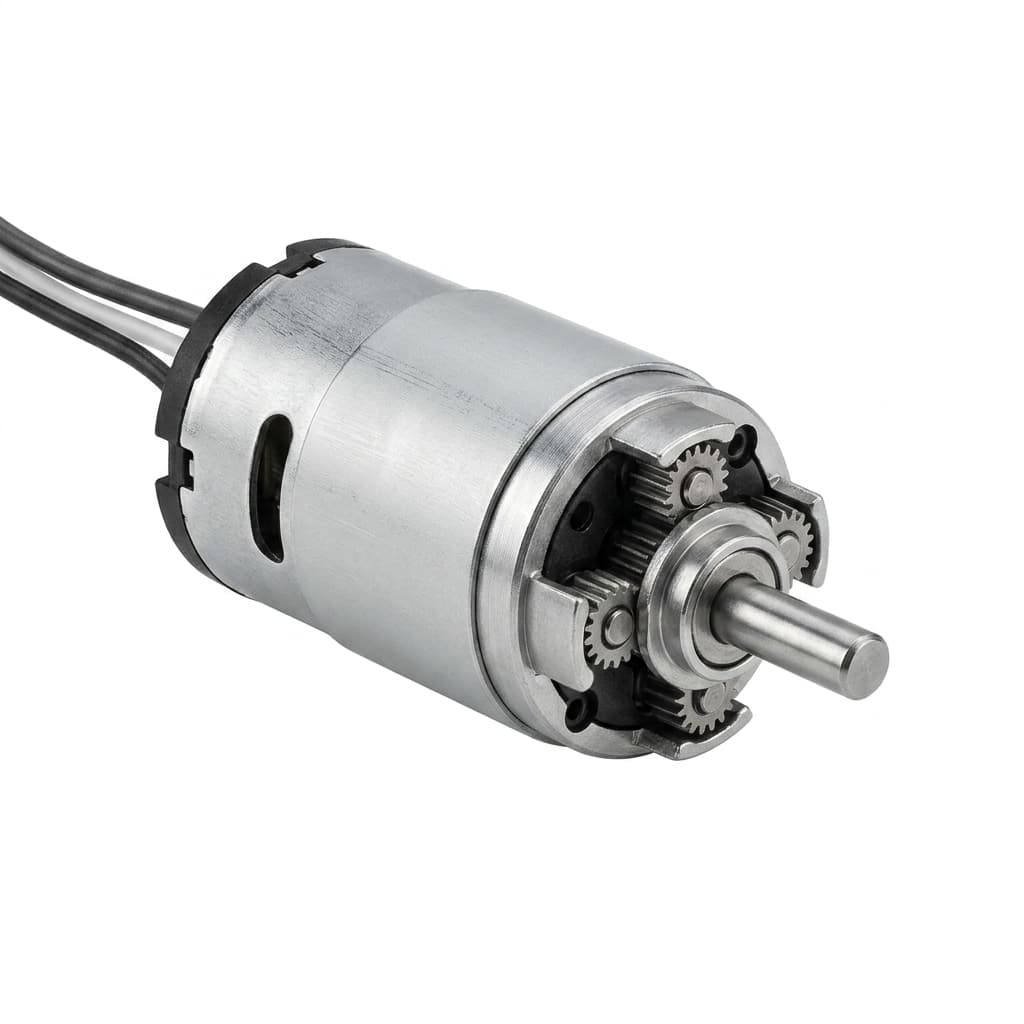
Understanding and Measuring Backlash in Micro Planetary Gearboxes
A practical engineering guide to backlash, arcminutes, static measurement, dynamic reversal behavior, and RFQ data for low-backlash micro planetary gear motor programs.
Backlash is the small amount of lost motion that appears when a gearbox reverses direction. In a micro planetary gearbox, it comes from the clearance needed between gear teeth, carrier pins, bearings, shafts, and the final output connection.
For a smart lock or valve actuator, a small amount of backlash may not matter. For a lens focus drive, inspection stage, robotic joint, or encoder-controlled actuator, the same clearance can become the reason the mechanism misses its repeatability target.
This guide explains how to define backlash, how to measure it, and what to send during RFQ so a low-backlash claim can be tied to a real acceptance method.
1. What Backlash Means
Backlash is usually reported as an angle at the gearbox output shaft. The common unit is arcminutes.
- 1 degree = 60 arcminutes
- 1 arcminute = 1/60 degree
- 0.5 degrees = 30 arcminutes
The important detail is where the angle is measured. Backlash measured at the gearbox output shaft is not the same as total lost motion at the end of a lever, belt, coupler, or lens mechanism. Mounting compliance and shaft fit can add error after the gearbox.
2. Convert Linear Play Into Arcminutes
In small mechanisms, backlash is often measured with a dial indicator at a known radius rather than directly with a rotary encoder.
Use this approximation:
angle in radians = measured movement / measurement radius
backlash in arcminutes = angle in radians x 3437.75
Example: if a dial indicator shows 0.05 mm of movement at a 20 mm radius:
0.05 / 20 x 3437.75 = 8.59 arcminutesThat number is only useful if the fixture radius, applied torque, input lock method, and measurement direction are recorded. Without the test condition, two suppliers can report different backlash values for the same gearbox.
3. Static Backlash Measurement
A practical static test uses a fixture, a torque-limited load, and a dial indicator or encoder.
- Lock the input shaft or motor shaft so the motor does not rotate.
- Attach a lever arm, pulley, or test disk to the output shaft.
- Apply a small alternating torque in the clockwise and counterclockwise directions.
- Measure the free output movement before the gear teeth re-engage.
- Convert the measured movement into degrees or arcminutes.
The preload torque matters. A very light touch may measure only loose clearance. Too much torque may twist the shaft, deform the fixture, or include elastic compliance that is not pure backlash.
For RFQ review, define:
- Input lock method
- Measurement radius
- Applied reversal torque
- Test temperature
- Lubricant condition
- Whether the limit applies before and after life testing
4. Dynamic Reversal Behavior Is Different
Static backlash is not the same as closed-loop positioning error during motion. Dynamic reversal behavior also includes controller tuning, motor inertia, gear friction, grease drag, load inertia, encoder resolution, and structural stiffness.
An encoder on the motor side can measure motor shaft movement, but it cannot remove mechanical clearance after the encoder. If the encoder is mounted before the gearbox, the controller may believe the motor has moved correctly while the output shaft is still taking up gear clearance.
[!NOTE] Engineering Review: Encoder Placement For precision positioning, state whether feedback is measured at the motor, gearbox output, or final mechanism. Motor-side feedback improves control visibility, but output-side feedback is the only way to directly observe total lost motion after the gear train.
5. Practical Backlash Grades
Use backlash grades as a starting point, not as a substitute for test conditions.
| Build Direction | Typical Backlash Range | Good Fit |
|---|---|---|
| Economy planetary gearbox | 30-90 arcminutes | Smart locks, valves, shutters, dispensers, and mechanisms with end stops |
| Reduced-backlash build | 10-30 arcminutes | Cameras, pumps, compact instruments, and light positioning mechanisms |
| Precision low-backlash build | 3-10 arcminutes | Optical focus, inspection stages, metrology fixtures, and small robotic joints |
| Ultra-tight custom review | Under 3 arcminutes | Special preload, output feedback, or custom gear design programs |
Tighter is not always better. Reducing clearance can increase friction, noise, current draw, assembly cost, and sensitivity to grease or temperature. In very small gearboxes, the practical target must be balanced against the gear module, stage count, bearing support, and expected production volume.
6. What Actually Reduces Backlash
Several design choices can reduce lost motion, but each has a tradeoff.
- Better gear tooth accuracy reduces variation, but raises tooling and process control cost.
- Tighter center distance reduces clearance, but can increase friction and current.
- Stronger carrier pins and output bearings reduce compliance under reversal load.
- Fewer gearbox stages reduce accumulated play, but may not provide enough ratio.
- Carefully selected grease improves feel, but viscosity changes with temperature and life.
- Output-side feedback can compensate for final mechanism error, but adds sensors and wiring.
For many micro planetary gear motor programs, the best result is not the smallest catalog backlash number. It is the lowest repeatable lost motion that still meets noise, life, current, torque, and production cost targets.
7. RFQ Data for Low-Backlash Programs
Send these details before asking for a low-backlash sample:
- Maximum acceptable backlash in arcminutes, degrees, or measured movement at a stated radius
- Whether the limit is measured at the gearbox output or final mechanism
- Reversal load, output shaft load, and direction-change frequency
- Target gear ratio, loaded output speed, and continuous torque
- Motor type: coreless DC, brushed DC, BLDC, indexed drive, or customer-supplied motor
- Encoder or Hall requirement, including whether feedback is motor-side or output-side
- Noise, current, temperature, duty cycle, and life-test limits
- Prototype quantity, annual forecast, and whether tooling changes are acceptable
For a focused starting point, compare our low-backlash micro planetary gear motors, encoder micro planetary gear motors, and optical instrument drive applications. If the ratio and torque target are still open, use the gear ratio and torque calculator before sending the RFQ.
Send backlash, torque, and feedback requirements to engineering so the sample proposal can include a measurement method instead of a catalog-only claim.
Author

Categories
More Posts
Coreless vs. Brushless Micro Planetary Motors: Which One to Use?
An in-depth engineering comparison between coreless DC and brushless DC (BLDC) micro planetary gear motors, including TCO, lifespan, and control complexity.
Gear Motor Failure Analysis: Micro-pitting and Tooth Flank Wear in Micro Planetary Gearboxes
Diagnose micro planetary gearbox failures by reading wear patterns, micro-pitting, lubricant breakdown, backlash growth, shaft loads, and validation data before pilot release.
How to Choose the Right Micro Planetary Gear Motor for Your Application
A comprehensive buyer-side engineering guide on sizing, torque requirements, gear materials, and selecting the optimal micro planetary gear motor architecture.