
RoHS Lead Exemptions, REACH SCIP, and PFAS Rules for Micro Planetary Gear Motors: 2026–2027 OEM BOM & RFQ Guide
Navigate EU RoHS Directive (EU) 2025/2364 lead-in-alloy deadlines, REACH SVHC SCIP reporting, and ECHA PFAS updates for micro planetary gear motor BOMs and RFQs.
A "RoHS Compliant" line on a micro planetary gear motor datasheet no longer protects an OEM shipment or an upcoming European product launch. Under Commission Delegated Directive (EU) 2025/2364, legacy lead-in-metal exemptions are splitting and expiring across December 11, 2026, June 11, 2027, and June 30, 2027. Meanwhile, REACH Article 33 and the ECHA SCIP database already require component-level reporting whenever an individual alloy part exceeds 0.1% weight by weight (w/w) of lead—even when a RoHS exemption still applies. In parallel, ECHA's universal PFAS restriction proposal has progressed through the Committee for Risk Assessment (RAC) final opinion (March 2026) and the Committee for Socio-Economic Analysis (SEAC) draft opinion and public consultation (March–May 2026), with SEAC's final opinion scheduled for SEAC-73 (November–December 2026) and expected by the end of 2026—putting PFPE greases, PTFE thickeners, FKM shaft seals, and fluoropolymer lead wires under active EU regulatory review.
Published: November 21, 2026. Scope: global OEM engineering and procurement of 6–32 mm micro planetary gear motors for EU/EEA and global regulated markets. This guide summarizes publicly verifiable EU regulatory milestones and their mechanical/procurement impact on miniature gearmotor Bills of Materials (BOMs). It is engineering and sourcing guidance—not formal legal counsel—and does not certify any specific part number without a model-specific Full Material Declaration (FMD) and test record.
If your program already has an EU market target or an upcoming medical/industrial audit, request a compliance and BOM review with your target EEE category, operating temperature, and annual volume.
1. Why 2026–2027 Material Compliance Hits Micro Gearmotors Differently
A 10 mm to 32 mm planetary gear motor looks like a single SKU on an OEM purchasing order, but EU chemical law treats it as a complex object assembled from 10 to 20 distinct sub-articles. Under REACH's "once an article, always an article" principle, concentration thresholds are calculated against each individual sub-component (a single brass bushing, a single output shaft, or a single carrier pin), not against the total mass of the assembled motor.
In miniature drives, three material families create almost all compliance friction:
- Free-machining leaded steel (
12L14/11SMnPb30) used for small-diameter output shafts, planet carrier pins, and sun-gear blanks to achieve tight concentricity and clean chip breaking on Swiss-type lathes. - Leaded brass (
C36000/CuZn39Pb3) used for sleeve bushings, bearing retainers, spacers, and brush-holder terminals. - Fluorochemicals (PFAS) used in wide-temperature PFPE base oils, PTFE-thickened greases, FKM (fluoroelastomer) lip seals or O-rings, PTFE thrust washers, and FEP/PTFE motor lead insulation.
When procurement teams only ask for a single top-level "RoHS 3 Certificate," suppliers frequently issue a generic statement based on current exemptions without flagging upcoming expiry dates or SVHC reporting triggers. By the time a customer's compliance portal rejects the BOM, the engineering team has only weeks to re-qualify a shaft alloy or lubricant.
2. RoHS Delegated Directive (EU) 2025/2364: Lead-in-Metal Expiry Schedule
On September 8, 2025, the European Commission adopted Commission Delegated Directive (EU) 2025/2364, published in the Official Journal on November 21, 2025 and entering into force on December 11, 2025 (with Member State transposition due June 30, 2026 and application from July 1, 2026). Rather than renewing broad legacy exemptions indefinitely, the directive splits Annex III lead-in-alloy entries into narrower sub-exemptions with hard calendar cutoffs.
| RoHS Annex III Entry | Material & Lead Limit | Micro Gearmotor Sub-Components Affected | Expiry Date(s) Under (EU) 2025/2364 | Procurement & Engineering Action |
|---|---|---|---|---|
| 6(a) | Lead as alloying element in steel for machining & galvanized steel (≤0.35% Pb w/w) | Parent entry covering legacy free-machining steel parts | December 11, 2026 | Stop citing generic 6(a) in new declarations; migrate to 6(a)-I or lead-free steel |
| 6(a)-I | Lead in steel for machining purposes (≤0.35% Pb w/w) | 12L14 / 11SMnPb30 output shafts, carrier pins, sun blanks | June 30, 2027 (all categories; child-access restriction applies) | Validate 1215, 303/316 stainless, or 17-4PH shaft runout and cost |
| 6(a)-II | Lead in batch hot-dip galvanized steel (≤0.2% Pb w/w) | External mounting brackets or stamped hardware | June 30, 2027 (all categories; child-access restriction applies) | Confirm zinc-plated / stainless brackets are lead-free |
| 6(b) | Lead in aluminum (≤0.4% Pb w/w) | Parent entry for legacy machined aluminum housings | June 11, 2027 | Migrate declarations to 6(b)-I, 6(b)-II, or 6(b)-III or lead-free 6061/6082 |
| 6(b)-I | Lead in aluminum from lead-bearing scrap recycling (≤0.4% Pb w/w) | Recycled aluminum motor end-bells or mounting flanges | December 11, 2026 (Cat 1–7, 10); June 30, 2027 (Cat 9, 11) | Audit Cat 1–7/10 housings immediately before Dec 2026 cutoff |
| 6(b)-II | Lead in aluminum for machining purposes (≤0.4% Pb w/w) | CNC-machined aluminum gearbox housings or encoder adapters | June 11, 2027 (Cat 1–7, 10); June 30, 2027 (Cat 9, 11) | Specify lead-free 6061-T6 or 6082-T6 on new drawings |
| 6(b)-III | Lead in aluminum casting alloys from recycling (≤0.3% Pb w/w) | Die-cast motor brackets or gearhead adapters | June 30, 2027 (Cat 1–8, non-ind. 9, 10) | Verify ingot mill cert Pb levels below 0.1% for long-life SKUs |
| 6(c) | Copper alloy containing up to 4% lead by weight | C36000 / CuZn39Pb3 sleeve bushings, spacers, brush terminals | June 30, 2027 (child-access exclusions apply) | Qualify lead-free silicon/bismuth brass or sintered bronze (SAE 841) |
Why Switching Out of 12L14 and C36000 Is Not a Drop-In Paperwork Edit
In sub-22 mm planetary gearboxes, output shafts (2.0 mm to 6.0 mm diameter) and planet carrier pins (0.8 mm to 2.0 mm diameter) require tight concentricity and low surface roughness (Ra). Lead in 12L14 and C36000 acts as an internal chip breaker and cutting-edge lubricant. When a machine shop switches to lead-free carbon steel (1215) or austenitic stainless steel (SUS303 / SUS304) without adjusting tooling, feeds, and speeds:
- Burr formation and pin-hole out-of-roundness increase, raising gear mesh transmission error and acoustic noise.
- Work-hardening in stainless grades can increase cycle time and tool wear, shifting unit cost on high-volume 10 mm and 16 mm gearmotors.
- Sleeve bushing galling can occur if a leaded brass bushing is replaced with an unlubricated lead-free brass without verifying shaft hardness and grease compatibility.
Before approving a lead-free alloy substitution, engineering teams should require first-article dimensional reports (runout, D-flat tolerance, pin parallelism) and loaded acoustic/life checks—not just a material certificate. See our shaft radial and axial load engineering guide for how shaft material and bearing support interact under side loads.
3. REACH Article 33 & ECHA SCIP: The 0.1% w/w Article-Level Trap
Many buyers assume that if a gearmotor is legally RoHS-compliant under Exemption 6(a)-I or 6(c), no further chemical action is needed until 2027. That assumption fails under EU REACH and the Waste Framework Directive.
Lead metal (CAS 7439-92-1) is on the REACH Candidate List of Substances of Very High Concern (SVHCs). Whenever an individual sub-article in a gearmotor contains lead above 0.1% w/w:
- REACH Article 33 requires the supplier to communicate safe-use information (at minimum, the SVHC name) down the B2B supply chain immediately upon supply, and to consumers within 45 days upon request.
- ECHA SCIP Database notification is mandatory for any EU producer, assembler, or importer placing the product on the EU market—with zero minimum tonnage threshold (unlike REACH Article 7(2), which carries a 1-tonne/year threshold).
Worked Screening Example: Why Whole-Motor Weight Hides SVHC Triggers
Consider a 16 mm planetary gear motor with a total assembly mass of 45.0 g. Suppose it uses a single C36000 brass sleeve bushing weighing 1.8 g containing 2.5% lead by weight (0.045 g of lead).
- Incorrect whole-motor calculation:
0.045 g / 45.0 g = 0.10%— a naive spreadsheet might treat this as borderline or exempt. - Correct EU article-level calculation:
2.5% w/winside the1.8 gbushing exceeds0.1% w/wby 25×. Because the bushing is a distinct article, REACH Article 33 and SCIP notification are legally triggered, regardless of how heavy the rest of the motor is.
Sourcing takeaway: For any program shipping into the EU/EEA today, either specify <0.1% Pb across all machined steel, brass, and aluminum sub-articles, or require the supplier's SCIP number and Article 33 SVHC table as part of PPAP/FAI approval.
4. ECHA Universal PFAS Restriction Status (Late 2026): Greases, Seals, and Wires
ECHA's evaluation of the universal PFAS (per- and polyfluoroalkyl substances) restriction proposal is in its final committee stage. The Committee for Risk Assessment (RAC) adopted its final opinion in March 2026, and the Committee for Socio-Economic Analysis (SEAC) agreed on its draft opinion in March 2026, followed by a public consultation from March 26 to May 25, 2026. Under ECHA's official work plan, SEAC's final opinion is scheduled for discussion and adoption at SEAC-73 (November–December 2026) and is expected by the end of 2026, after which ECHA will submit both final opinions to the European Commission and Member States (via the REACH Committee) for legislative drafting.
Because SEAC's final opinion is still pending and the European Commission has not yet issued a legislative restriction draft, the final restriction scope, transition periods, and any sector-specific derogations remain undecided. Even so, OEMs designing 5-to-10-year product platforms in late 2026 should map fluorochemical dependencies early rather than treating them as risk-free defaults.
| Gearmotor Sub-Component | Common PFAS Material | Why Engineers Specify It | Non-PFAS Alternative | Engineering Trade-Off & Qualification Risk |
|---|---|---|---|---|
| Gearbox Grease (Base Oil) | PFPE (perfluoropolyether) | Extreme thermal stability (-40°C to +150°C+), very low vapor pressure, plastic compatibility | Synthetic PAO (polyalphaolefin) or ester blends | Narrower upper temp ceiling, higher evaporation/oil bleed over long life; must re-test cold-start torque |
| Grease Thickener / Solid Additive | PTFE micropowder | Low boundary friction, reduced gear mesh wear and noise in metal/plastic stages | Lithium-complex, polyurea, or modified hBN / MoS2 | Different shear stability and acoustic damping; risk of noise shift or wear increase at stall/peak load |
| Dynamic Shaft Lip Seal | FKM (Viton® / fluoroelastomer) | Chemical resistance, high surface speed thermal margin (+150°C+) | HNBR (hydrogenated nitrile) or EPDM (application-dependent) | HNBR handles -40°C to +135°C well, but swells differently in ester/PAO greases; verify IP65/IP68 seal drag |
| Output & Carrier Thrust Washers | Pure PTFE or PTFE-filled POM/PA | Low dry/boundary friction against carrier face | UHMWPE, PEEK (unfilled or graphite-filled), or PA46 | Higher initial breakaway friction if grease film is starved; verify axial preload wear |
| Motor Lead-Wire Insulation | FEP / PTFE fluoropolymer jacket | Thin wall in tight housings, solder-iron & high-temp resistance | Cross-linked XLPE or high-temp silicone rubber | Slightly thicker outer jacket or softer abrasion resistance; check housing grommet clearance |
| PCB / Driver Conformal Coating | Fluoropolymer barrier coating | Moisture & chemical protection on integrated BLDC/encoder PCBs | Acrylic, polyurethane, or parylene (non-fluorinated) | Re-verify dielectric withstand and condensation protection under IEC 60601 / IP tests |
For a deeper look at how PAO vs. PFPE base oils affect -40°C breakaway current and +125°C oil bleed, see our wide-temperature lubrication guide. For elastomer compatibility in washdown or outdoor actuators, review our IP65/IP68 dynamic sealing guide.
5. Engineering & Procurement Trade-Offs: Avoiding Silent BOM Substitutions
The biggest compliance failure mode in B2B motor sourcing is the silent substitution: a sub-tier workshop swaps a leaded brass bushing or a PTFE-thickened grease to meet a customer's compliance deadline without issuing a Product Change Notice (PCN) or re-running functional qualification.
When to Transition Now vs. When to Document an Exemption
- Transition immediately if you are launching a new medical, consumer, or industrial platform with a 5+ year production horizon, or if your assembly relies on parent entry
6(a)or Category 1–7/106(b)-I(expiring December 11, 2026). - Document and schedule transition if an existing legacy SKU uses
6(a)-Ishafts or6(c)brass bushings (expiring June 30, 2027), ensuring your supplier provides a dated phase-out plan and sample lot for mechanical re-qualification at least 6 months prior. - Map PFAS early even while SEAC's final opinion (scheduled for SEAC-73 in November–December 2026) and any subsequent European Commission legislative text remain pending—especially for medical devices, food/beverage dispensers, and automotive/industrial OEMs with corporate PFAS phase-out mandates.
6. OEM RFQ & Incoming Material Compliance Checklist
Include these four verification blocks in your next micro planetary gear motor RFQ or supplier quality agreement:
Phase 1: Sub-Article BOM & Declaration Granularity
- No generic top-level letters: Require a sub-component Full Material Declaration (FMD) or
IPC-1752AClass C/D XML covering shaft, carrier pins, gears, bushings, housing, seals, grease, lead wires, and solder. - Explicit RoHS exemption disclosure: Require the supplier to state whether compliance relies on
(EU) 2025/2364exemptions (6(a)-I,6(b)-II,6(c)) and list the exact expiry date for your EEE category.
Phase 2: REACH SVHC & SCIP Readiness
- Article-level
0.1% w/wcheck: Confirm lead (CAS 7439-92-1) and any other Candidate List SVHC concentration per individual sub-article, not by total motor weight. - SCIP & Article 33 package: If any sub-article exceeds
0.1% w/w, require the supplier's safe-use statement (Article 33) and SCIP reference data prior to first production shipment.
Phase 3: PFAS Inventory & Alternative Qualification
- Fluorochemical disclosure: Flag any PFPE base oil, PTFE grease thickener, PTFE thrust washer, FKM seal, or FEP/PTFE wire insulation in the BOM.
- Matched grease-elastomer testing: If migrating to non-PFAS grease (e.g., PAO/ester) and HNBR/EPDM seals, require cold-start torque, high-temperature bleed, and seal-swell verification under your exact duty cycle.
Phase 4: Change Control (PCN) & Incoming Audit
- Mandatory PCN clause: Prohibit unannounced alloy, grease, seal, or sub-tier machine shop changes. Require 90–180 days advance written notice and sample re-qualification.
- Incoming XRF / CoA spot checks: Align incoming inspection with XRF screening on shafts, pins, and brass bushings to catch accidental
12L14orC36000mix-ups on the shop floor.
7. Frequently Asked Questions (FAQ)
Q1: Does a RoHS exemption like 6(a)-I or 6(c) exempt a gearmotor from REACH SCIP reporting?
No. RoHS and REACH/WFD are separate legal frameworks. Even when a 12L14 steel shaft (<=0.35% Pb) or C36000 brass bushing (<=4% Pb) is legally compliant under RoHS Annex III until June 30, 2027, lead is a REACH Candidate List SVHC. Because the concentration inside that individual sub-article exceeds 0.1% w/w, REACH Article 33 communication and ECHA SCIP notification still apply when placing the product on the EU market.
Q2: Why does ECHA's PFAS evaluation matter now if SEAC's final opinion and EU legislation are still pending?
With RAC's final opinion adopted in March 2026 and SEAC's draft opinion already through public consultation ahead of its final opinion scheduled for SEAC-73 (November–December 2026, expected by end of 2026), ECHA's committee review is nearing completion before handoff to the European Commission. Although final restriction terms, transition timelines, and any derogations are not yet determined, qualifying a new PAO grease, HNBR seal, or XLPE wire harness in a micro planetary gearbox takes 3–9 months of endurance, thermal, and IP testing. Starting BOM mapping now prevents emergency redesigns during active production.
Q3: Can we replace a 12L14 steel output shaft with SUS303 or 1215 without changing tolerances?
Not automatically. Lead-free carbon steel (1215) and stainless steel (SUS303 / SUS304) machine differently from 12L14, affecting chip evacuation, burr control on D-flats/keyways, and surface finish on 2–6 mm shafts. Always verify radial runout, bearing press-fit retention, and radial load capacity on first-article samples.
Q4: Are medical devices (IEC 60601 / RoHS Category 8) affected by the same 2026–2027 deadlines?
Yes, under Commission Delegated Directive (EU) 2025/2364, 6(a)-I, 6(a)-II, and 6(c) carry a June 30, 2027 expiry date across all categories (while 6(b)-I and 6(b)-II distinguish Categories 1–7/10 from Categories 9 and 11). Additionally, medical OEMs must maintain strict material traceability and chemical compliance documentation for quality-system and regulatory audits (alongside electrical safety requirements under IEC 60601-1), making early FMD disclosure essential.
Q5: What happens if we swap a PFPE/PTFE grease for a PFAS-free PAO grease in an existing gearbox?
Switching base oil chemistry changes viscosity-temperature behavior, oil bleed rate, and elastomer compatibility. A PAO grease may show different cold-start drag at -30°C to -40°C, faster evaporation above +100°C, or swelling/hardening on existing FKM or nitrile seals. Treat any grease change as a full mechanical re-qualification event.
Q6: What should a procurement team ask for in an RFQ to avoid compliance surprises?
Ask for: (1) an IPC-1752A or sub-article FMD table, (2) explicit disclosure of any RoHS (EU) 2025/2364 exemptions used, (3) an article-level REACH SVHC (>0.1% w/w) statement, (4) a PFAS presence inventory (grease, seals, washers, wire jacket), and (5) a written PCN lock preventing unapproved alloy or lubricant substitutions.
8. Authoritative References & Standards
- EUR-Lex — Commission Delegated Directive (EU) 2025/2364. Official Journal text amending RoHS Directive 2011/65/EU Annex III exemptions
6(a),6(a)-I,6(a)-II,6(b),6(b)-I,6(b)-II,6(b)-III, and6(c)for lead in steel, aluminum, and copper alloys, including entry-into-force and expiry dates. - ECHA — Universal PFAS Restriction Proposal (Hot Topics). Official regulatory status tracking RAC's final opinion (March 2026), SEAC's draft opinion and consultation (March–May 2026), and the pending SEAC final opinion scheduled for SEAC-73 (November–December 2026, expected by end of 2026) prior to submission to the European Commission.
- ECHA — SCIP Database. Official Waste Framework Directive obligations for suppliers placing articles or complex objects containing Candidate List SVHCs above
0.1% w/won the EU market, with no minimum tonnage threshold. - ECHA — Candidate List Substances in Articles. Official guidance on the article-level
0.1% w/wrule, REACH Article 33 supply-chain communication, and Article 7(2) notification duties.
Source check: November 21, 2026. Regulatory dates and committee milestones reflect official EU publications as of November 21, 2026. Component weights and lead percentages in the worked screening example are illustrative engineering scenarios, not test measurements of a specific SKU. Confirm exact EEE category applicability and exemption status with your compliance counsel and motor supplier.
Technical Support & Compliance-Ready Actuator Engineering
Need lead-free shaft/bushing options, PFAS-free grease and seal qualification, or a sub-article FMD package for your next European or global OEM program?
- Review our manufacturing controls and incoming inspection standards on our quality assurance page.
- Explore our full range of micro planetary gear motors and specialized medical device actuator solutions.
- Request 3D models and dimensional drawings through our CAD STEP request portal.
- → Contact our engineering application team with your target EEE category, operating temperature range, envelope, and compliance declaration requirements for an engineering DFM review and sample quotation.
Author

Categories
12L14 and C36000 Is Not a Drop-In Paperwork Edit3. REACH Article 33 & ECHA SCIP: The 0.1% w/w Article-Level TrapWorked Screening Example: Why Whole-Motor Weight Hides SVHC Triggers4. ECHA Universal PFAS Restriction Status (Late 2026): Greases, Seals, and Wires5. Engineering & Procurement Trade-Offs: Avoiding Silent BOM SubstitutionsWhen to Transition Now vs. When to Document an Exemption6. OEM RFQ & Incoming Material Compliance ChecklistPhase 1: Sub-Article BOM & Declaration GranularityPhase 2: REACH SVHC & SCIP ReadinessPhase 3: PFAS Inventory & Alternative QualificationPhase 4: Change Control (PCN) & Incoming Audit7. Frequently Asked Questions (FAQ)Q1: Does a RoHS exemption like 6(a)-I or 6(c) exempt a gearmotor from REACH SCIP reporting?Q2: Why does ECHA's PFAS evaluation matter now if SEAC's final opinion and EU legislation are still pending?Q3: Can we replace a 12L14 steel output shaft with SUS303 or 1215 without changing tolerances?Q4: Are medical devices (IEC 60601 / RoHS Category 8) affected by the same 2026–2027 deadlines?Q5: What happens if we swap a PFPE/PTFE grease for a PFAS-free PAO grease in an existing gearbox?Q6: What should a procurement team ask for in an RFQ to avoid compliance surprises?8. Authoritative References & StandardsTechnical Support & Compliance-Ready Actuator EngineeringMore Posts
Coreless vs. Brushless Micro Planetary Motors: Which One to Use?
An in-depth engineering comparison between coreless DC and brushless DC (BLDC) micro planetary gear motors, including TCO, lifespan, and control complexity.
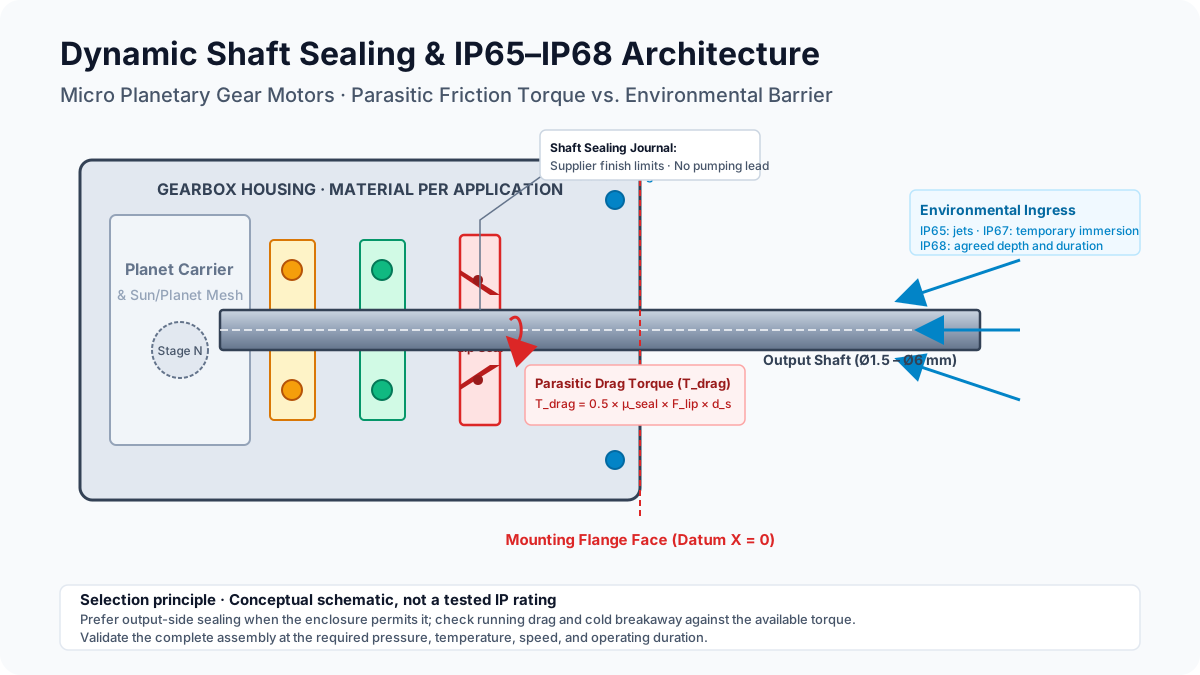
Dynamic Shaft Sealing and IP65 to IP68 Protection in Micro Planetary Gear Motors: Parasitic Drag Torque, Seal Architectures, and Waterproof Actuator Engineering
Specify IP65 to IP68 micro planetary gear motors: compare shaft seals, budget drag torque, assess thermal pumping, and prepare an engineering RFQ checklist.
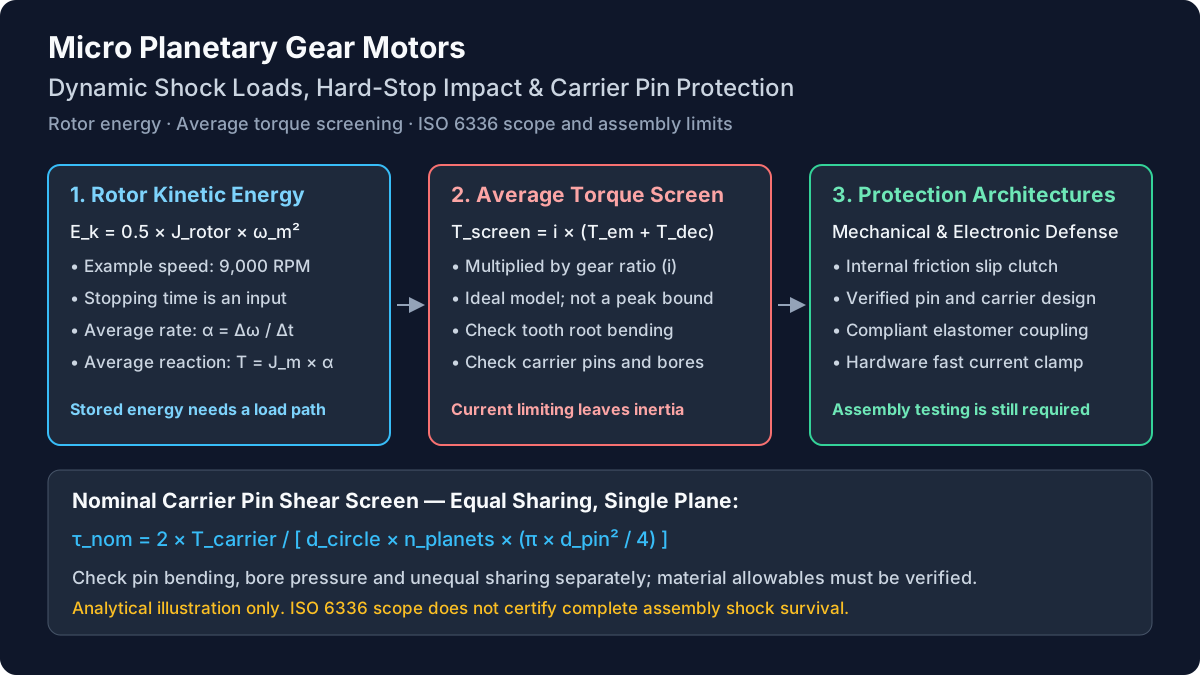
Shock Load Rating and Dynamic Impact Torque in Micro Planetary Gear Motors: Rotor Inertia Dissipation, Carrier Pin Shear, and ISO 6336 Peak Overload Sizing
Size micro planetary gear motors for shock loads with a rotor inertia example, carrier pin checks, ISO 6336 limits, and a practical checklist. Request a review.